Introduction
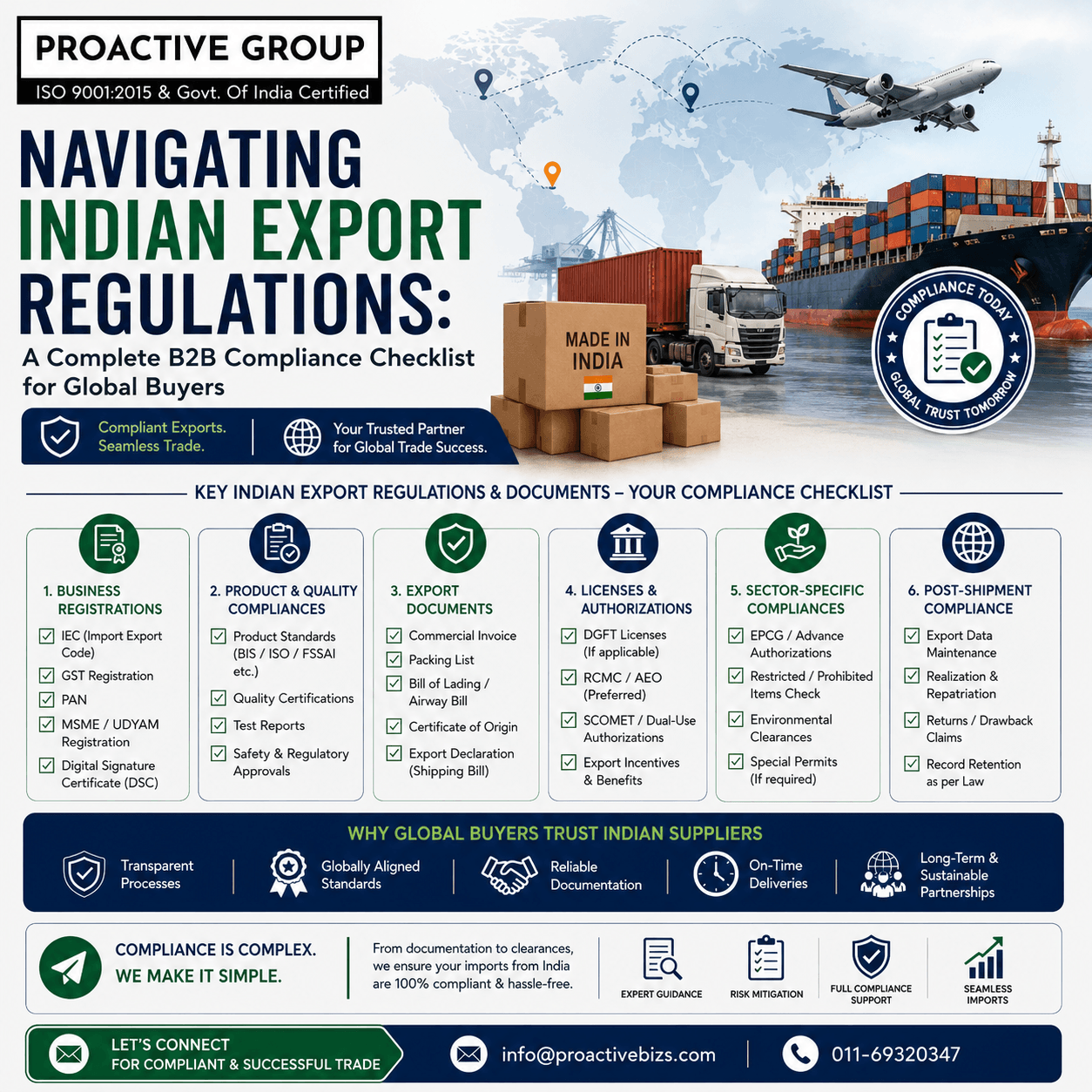
India has become one of the world’s most important sourcing destinations for manufacturers, distributors, wholesalers, retailers, and institutional buyers seeking reliable supply chains and competitive production costs. From engineering goods and industrial equipment to textiles, food products, chemicals, pharmaceuticals, and private-label consumer products, India continues to strengthen its position as a global export powerhouse.
However, successful international procurement depends on more than finding the right supplier. For global buyers operating in the United States, United Kingdom, European Union, Australia, the Middle East, and other international markets, regulatory compliance remains one of the most critical aspects of cross-border trade.
A minor documentation error, incorrect tariff classification, missing certificate, or customs compliance issue can result in shipment delays, customs examinations, demurrage charges, financial penalties, or disruption of supply chains.
Fortunately, India’s export framework is well-structured, transparent, and globally integrated. Businesses that understand the regulatory requirements can significantly reduce trade risks while improving procurement efficiency.
This guide explains the essential registrations, export documents, customs procedures, tax frameworks, and compliance requirements that global buyers should understand when sourcing products from India.
Why Export Compliance Matters
Export compliance is not merely a legal requirement—it is a business necessity.
Proper compliance helps businesses:
- Avoid customs delays
- Prevent financial penalties
- Reduce demurrage and detention costs
- Improve shipment predictability
- Protect profit margins
- Strengthen supplier relationships
- Improve supply chain resilience
A compliant export transaction moves faster, faces fewer disruptions, and creates a better experience for both buyers and suppliers.
Understanding India’s Export Regulatory Framework
India’s export ecosystem is regulated through a combination of:
- Directorate General of Foreign Trade (DGFT)
- Central Board of Indirect Taxes and Customs (CBIC)
- Goods and Services Tax (GST) Network
- Reserve Bank of India (RBI)
- Export Promotion Councils
These institutions collectively ensure that exports are properly documented, legally compliant, and financially traceable.
Essential Registrations Required for Indian Exporters
Before any product can legally leave India, the exporter must possess specific registrations.
Import Export Code (IEC)
The Import Export Code is the foundational registration required for international trade.
Key Points
- Issued by DGFT
- Mandatory for most import-export transactions
- Unique identification number for exporters
Foreign buyers do not require an IEC. However, the Indian exporter must possess a valid and active IEC.
GST Registration
GST registration is essential for export-oriented businesses.
Benefits include:
- Tax compliance
- Export documentation support
- Refund eligibility
- LUT-based exports
GST compliance also improves transparency and credibility.
RCMC Registration
Registration Cum Membership Certificate (RCMC) may be required for exporters seeking benefits under India’s Foreign Trade Policy.
RCMC is generally issued through recognized Export Promotion Councils.
Quality and Compliance Certifications
Depending on the product category, suppliers may maintain certifications such as:
- ISO 9001
- HACCP
- GMP
- CE Compliance
- Industry-Specific Standards
These certifications help demonstrate operational reliability and quality management.
Essential Export Documentation Checklist
Every export shipment requires a structured documentation package.
Commercial Invoice
Defines:
- Product Description
- Quantity
- Unit Price
- Currency
- HS Code
- Buyer Details
The invoice forms the basis of customs valuation.
Packing List
Provides:
- Package Count
- Weight Details
- Dimensions
- Product Breakdown
This document supports logistics and customs operations.
Bill of Lading (BL)
Used for sea shipments.
Functions as:
- Transport Contract
- Cargo Receipt
- Document of Title
Airway Bill (AWB)
Used for air freight shipments.
Provides shipment tracking and transportation documentation.
Certificate of Origin (COO)
Certifies that goods originate from India.
Benefits include:
- Customs Verification
- Preferential Tariff Eligibility
- FTA Benefits
For many importers, this document directly impacts landed costs.
Shipping Bill
The primary customs document required for export clearance from India.
It serves as the official declaration submitted to customs authorities.
Understanding HS Codes and Tariff Classification
One of the most common compliance errors involves incorrect product classification.
What is an HS Code?
The Harmonized System (HS) Code is an internationally recognized product classification system.
Correct classification determines:
- Customs Duties
- Regulatory Requirements
- Trade Restrictions
- Reporting Obligations
Incorrect HS codes may lead to customs disputes and penalties.
Understanding Incoterms in International Trade
Global buyers should clearly define responsibilities using Incoterms.
FOB (Free on Board)
Exporter manages:
- Manufacturing
- Inland Transport
- Export Clearance
Buyer assumes responsibility once cargo is loaded.
CIF (Cost, Insurance and Freight)
Exporter additionally manages:
- International Freight
- Insurance
Buyer handles destination-side processes.
EXW (Ex Works)
Buyer assumes maximum responsibility from the supplier’s premises.
DDP (Delivered Duty Paid)
Exporter or logistics provider manages:
- Transportation
- Customs Clearance
- Duties
- Final Delivery
DDP offers the highest convenience for buyers.
Managing GST in Export Transactions
Exports from India generally receive special treatment under GST laws.
Zero-Rated Supplies
Exports qualify as zero-rated supplies under GST.
This framework helps prevent tax cascading and improves international competitiveness.
Letter of Undertaking (LUT)
A Letter of Undertaking allows eligible exporters to export goods without paying IGST upfront.
Benefits
- Improved Cash Flow
- Lower Working Capital Requirements
- Competitive Export Pricing
The LUT mechanism benefits both exporters and international buyers by reducing financial friction.
Bank Realisation Certificate (eBRC)
Export transactions must eventually be supported by proof of foreign currency realization.
What is eBRC?
Electronic Bank Realisation Certificate (eBRC) confirms that export proceeds have been received through authorized banking channels.
Importance
- Regulatory Compliance
- Export Incentive Eligibility
- Trade Documentation Integrity
A properly maintained eBRC trail demonstrates legitimate and compliant trade activity.
Secure International Payment Methods
Payment risk management is critical in global trade.
Advance Payment
Buyer pays before shipment.
Telegraphic Transfer (T/T)
Common structure:
- Partial Advance
- Balance Against Shipping Documents
Letter of Credit (LC)
One of the most secure payment mechanisms.
Benefits:
- Bank-backed assurance
- Reduced counterparty risk
- Greater transaction security
Documents Against Payment (DAP)
Documents released upon payment.
Documents Against Acceptance (DA)
Documents released upon acceptance of payment obligations.
Choosing the right payment structure reduces commercial risk.
Customs Clearance Process in India
A typical export transaction follows this sequence:
Supplier Production
↓
Commercial Documentation
↓
Shipping Bill Filing
↓
Customs Examination
↓
Export Clearance
↓
Cargo Loading
↓
International Shipment
↓
Foreign Import Clearance
↓
Delivery to Buyer
Understanding this process helps buyers coordinate procurement schedules more effectively.
Common Export Compliance Mistakes
Many international trade delays arise from preventable errors.
Common Issues
- Incorrect HS Codes
- Missing Certificates
- Documentation Mismatches
- Incomplete Commercial Invoices
- Incorrect Product Descriptions
- Payment Documentation Errors
- Incoterm Misunderstandings
A structured compliance review helps avoid these problems.
Export Compliance Checklist for Global Buyers
Before confirming a supplier relationship, verify:
✅ IEC Registration
✅ GST Registration
✅ Export Experience
✅ Product Certifications
✅ Correct HS Classification
✅ Certificate of Origin Availability
✅ Shipping Documentation Capability
✅ Banking Compliance
✅ Quality Control Processes
✅ Contract Terms Clearly Defined
This checklist significantly reduces procurement risk.
Why Businesses Choose PROACTIVE GROUP
PROACTIVE GROUP provides integrated export advisory, sourcing, procurement, compliance, and international trade support for global buyers.
Export Compliance Expertise
Support for documentation, customs, and trade regulations.
Supplier Verification
Access to verified manufacturers and exporters.
GST & Trade Advisory
Integrated tax and export compliance solutions.
Documentation Management
Support throughout the export lifecycle.
International Trade Coordination
Assistance with sourcing, procurement, logistics, and shipment management.
End-to-End Support
From supplier onboarding to final cargo delivery.
Frequently Asked Questions (FAQs)
Q1. Does a foreign buyer need an IEC?
No. The Indian exporter must possess a valid IEC. Foreign buyers do not require an IEC issued by India.
Q2. How does LUT benefit international buyers?
LUT allows exporters to avoid upfront IGST payments, improving cash flow and potentially reducing export pricing.
Q3. Why is a Certificate of Origin important?
It helps customs authorities verify product origin and may allow buyers to claim preferential tariff benefits under applicable trade agreements.
Q4. Who handles customs clearance under FOB terms?
Under FOB, the exporter manages export clearance while the buyer assumes responsibility once cargo is loaded onto the vessel.
Q5. What is the purpose of an eBRC?
It confirms receipt of export proceeds through authorized banking channels.
Q6. How can buyers reduce export compliance risks?
By working with compliant exporters, verifying documentation, confirming certifications, and implementing structured procurement procedures.
Q7. What is the most secure international payment method?
For larger transactions, an irrevocable Letter of Credit is generally considered one of the safest options.
Q8. Can documentation errors delay shipments?
Yes. Even minor discrepancies may trigger customs reviews, inspections, or shipment holds.
Conclusion
India’s export ecosystem is highly developed, transparent, and globally integrated. However, successful international procurement requires a clear understanding of registrations, documentation, tax compliance, customs procedures, payment structures, and trade regulations.
Businesses that implement structured export compliance processes benefit from smoother customs clearance, lower risk exposure, faster shipments, and stronger supplier relationships.
Whether sourcing industrial products, consumer goods, engineering equipment, textiles, agro-products, or private-label merchandise, a compliance-first approach remains the foundation of successful international trade.
