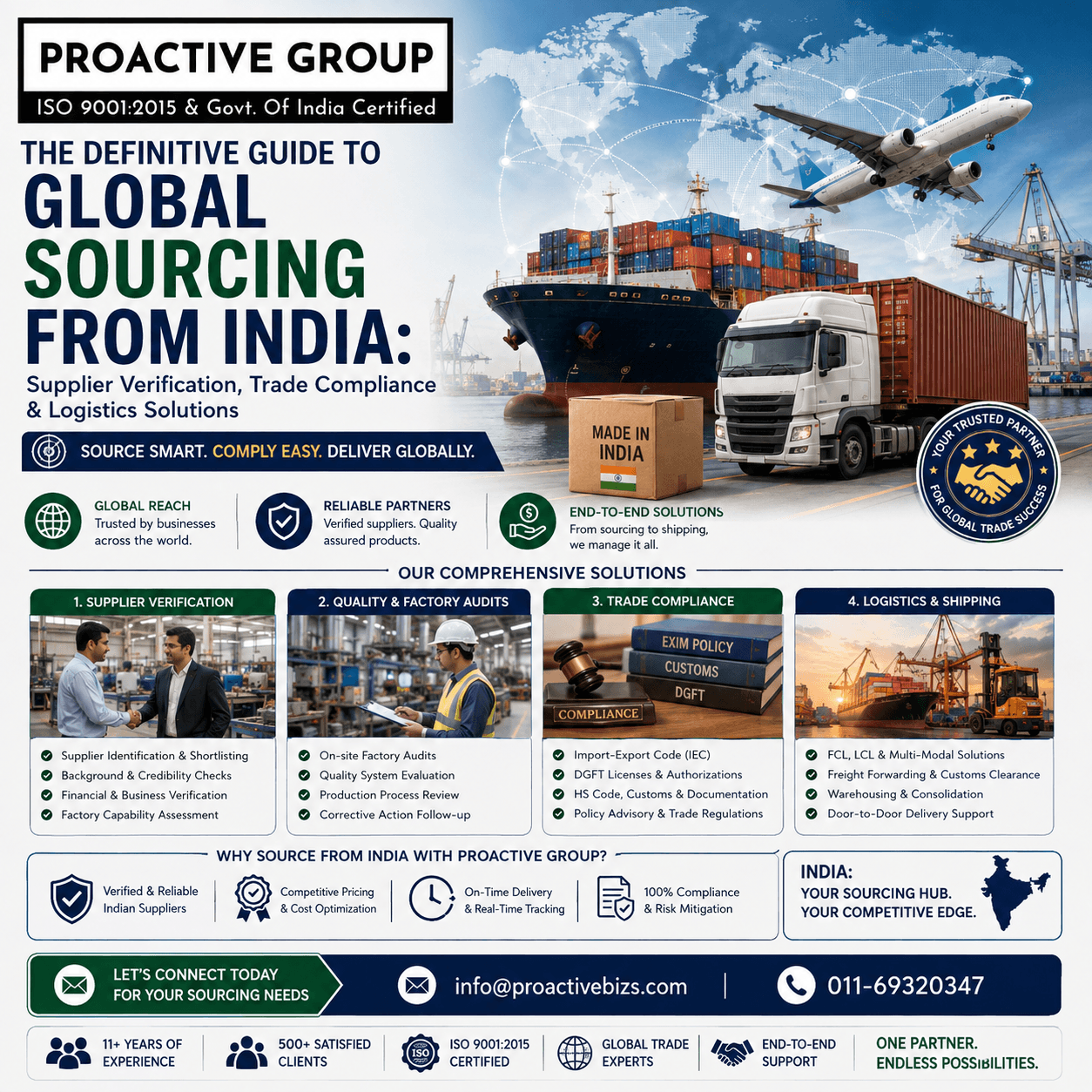
Introduction
As global corporations continue diversifying their supply chains to reduce geopolitical risks, increase procurement resilience, and improve operational flexibility, India has evolved from an alternative sourcing destination into one of the world’s most important manufacturing and export hubs.
Backed by large-scale infrastructure investments, a rapidly modernizing industrial sector, competitive manufacturing costs, a skilled workforce, and a highly regulated digital trade ecosystem, India offers international buyers access to scalable sourcing opportunities across virtually every major industry.
Whether sourcing premium textiles, agro-products, engineering goods, industrial components, chemicals, healthcare products, electronics, consumer goods, or private-label merchandise, global buyers increasingly view India as a strategic procurement destination.
However, sourcing successfully from thousands of miles away introduces significant challenges:
- How do you verify supplier legitimacy?
- How do you ensure consistent product quality?
- How do you protect intellectual property?
- How do you avoid customs delays and compliance issues?
- How do you optimize shipping costs while maintaining delivery reliability?
The answer lies in mastering four interconnected pillars:
The Four Pillars of Successful Global Sourcing
- Supplier Identification & Verification
- Quality Control & Factory Audits
- Trade Compliance & Export Documentation
- Logistics & Supply Chain Optimization
This comprehensive guide provides a practical framework for building a reliable, compliant, and profitable sourcing operation from India.
Why Global Buyers Are Sourcing from India
India’s manufacturing ecosystem continues to attract buyers from the United States, United Kingdom, Europe, Australia, the Middle East, Africa, and Asia-Pacific markets.
Competitive Manufacturing Costs
India offers strong cost advantages while maintaining access to skilled labor and modern production facilities.
China+1 Supply Chain Strategy
Many multinational organizations are diversifying procurement beyond single-country sourcing models to improve supply chain resilience.
Large Manufacturing Base
India supports sourcing across:
- Textiles & Apparel
- Agro Commodities
- Food Processing
- Engineering Goods
- Chemicals
- Pharmaceuticals
- Electronics
- Consumer Products
- Handicrafts & Lifestyle Products
Export-Friendly Policies
Government initiatives continue to strengthen India’s position as a global manufacturing and export destination.
Scalable Production Capacity
From MSMEs to multinational manufacturing facilities, India offers suppliers capable of supporting both small and large-volume procurement requirements.
Pillar 1: Global Product Sourcing & Supplier Verification
The foundation of every successful procurement operation begins with selecting the right supplier.
One of the biggest mistakes international buyers make is relying solely on online marketplaces and supplier directories without conducting independent verification.
A professional sourcing strategy requires a structured due diligence process.
Identifying the Right Supplier
Suppliers generally fall into four categories:
Manufacturers
Companies directly producing goods.
OEM Manufacturers
Factories producing products according to buyer specifications.
Contract Manufacturers
Manufacturers producing customized products under private-label arrangements.
Trading Companies
Organizations sourcing products from multiple factories.
Understanding which category a supplier belongs to helps establish realistic expectations regarding pricing, production capacity, and quality control.
High-Demand Sourcing Categories in India
Agro Commodities & Processed Foods
- Spices
- Tea
- Coffee
- Rice
- Oilseeds
- Cashew
- Processed Food Products
Textiles & Apparel
- Cotton Products
- Garments
- Home Furnishings
- Sustainable Fabrics
- Fashion Accessories
Chemicals & Healthcare
- Industrial Chemicals
- Pharmaceuticals
- APIs
- Cosmetics
- Medical Consumables
Industrial & Engineering Products
- Machinery
- Components
- Auto Parts
- Electrical Products
- Packaging Materials
Consumer & Lifestyle Products
- Leather Goods
- Handicrafts
- Jewelry
- Home Decor
- Retail Merchandise
Supplier Verification Framework
Before placing an order, buyers should verify:
Legal Compliance
- GST Registration
- Import Export Code (IEC)
- Business Registration
- Industry Certifications
Export Experience
Evaluate:
- Existing Export Markets
- Export Documentation Capability
- International Trade History
Financial Stability
Assess:
- Years of Operation
- Business Reputation
- Credit Standing
- Operational Continuity
Production Capacity
Verify:
- Manufacturing Infrastructure
- Machinery
- Workforce
- Scalability
This verification process significantly reduces procurement risks.
Pillar 2: Factory Audits & Quality Control
Quality assurance should begin before production—not after cargo reaches its destination.
Why Factory Audits Matter
A supplier may appear professional online but lack adequate manufacturing capability.
Factory audits verify:
Production Infrastructure
Actual manufacturing capacity.
Technology & Equipment
Condition and capability of machinery.
Workforce Strength
Availability of skilled labor.
Quality Management Systems
Internal inspection and testing procedures.
Export Readiness
Packaging, documentation, and logistics capabilities.
Social Compliance
Verification of:
- Fair Labor Practices
- Workplace Safety
- Environmental Compliance
- Ethical Manufacturing Standards
The Three-Stage Quality Control Framework
Phase 1: Initial Production Check (IPC)
Conducted before full production begins.
Objectives:
- Raw Material Verification
- Component Inspection
- Specification Validation
Phase 2: During Production Inspection (DUPRO)
Conducted when approximately 20–50% of production is complete.
Objectives:
- Process Monitoring
- Defect Identification
- Corrective Action Implementation
Phase 3: Final Random Inspection (FRI)
Conducted before shipment.
Inspection covers:
- Product Quality
- Packaging
- Labeling
- Quantity Verification
- Shipment Readiness
Sampling is generally based on internationally accepted AQL standards.
Procurement Risk Management Framework
Every sourcing project involves risk.
The objective is not eliminating risk entirely but managing it effectively.
| Risk | Impact | Mitigation |
|---|---|---|
| Supplier Fraud | High | Supplier Verification & Factory Audit |
| Quality Failure | High | IPC, DUPRO & FRI Inspections |
| Production Delay | Medium | Production Monitoring |
| Payment Risk | High | LC & Contractual Controls |
| Logistics Delay | Medium | Multi-Modal Planning |
| Customs Issues | High | Documentation Review |
| IP Leakage | High | NDA & Legal Agreements |
A structured risk management framework protects both capital and business continuity.
Private Label & OEM Manufacturing in India
India has become a preferred destination for:
- Private Label Manufacturing
- OEM Manufacturing
- White Label Products
- Contract Manufacturing
Benefits
Brand Ownership
Sell products under your own brand.
Better Margins
Private-label products typically offer higher profitability.
Product Customization
Tailored specifications and packaging.
Scalability
Manufacturing capacity grows alongside demand.
Intellectual Property Protection
Before sharing designs or formulations:
Execute NDAs
Protect confidential information.
Use Non-Circumvention Agreements
Prevent unauthorized business practices.
Define Ownership Rights
Clearly establish ownership of:
- Tooling
- Molds
- Product Designs
- Technical Specifications
- Branding Assets
Pillar 3: Trade Compliance & Export Documentation
Many international shipment delays occur due to documentation errors rather than production problems.
A compliance-first approach reduces customs delays and financial penalties.
Essential Export Registrations
Import Export Code (IEC)
Mandatory for most export transactions.
GST Registration
Supports tax compliance and export operations.
MSME Registration
Provides formal business recognition.
Industry Certifications
Depending on product category and market requirements.
Export Documentation Checklist
Commercial Invoice
Contains:
- Product Description
- Quantity
- Value
- Currency
- HS Codes
Packing List
Provides:
- Weight
- Dimensions
- Packaging Information
Bill of Lading (BL)
Required for sea freight.
Airway Bill (AWB)
Required for air freight.
Certificate of Origin (COO)
Confirms Indian origin of goods.
Shipping Bill
Primary customs clearance document.
Letter of Undertaking (LUT)
Supports zero-rated exports under GST.
HS Code Classification
Correct HS Code classification determines:
- Customs Duties
- Compliance Requirements
- Trade Restrictions
- Import Taxes
Incorrect classification may result in customs disputes and penalties.
Secure International Payment Structures
Choosing the right payment structure protects both buyer and supplier.
Advance Payment
Common for smaller transactions.
Telegraphic Transfer (T/T)
Typically:
- 30% Advance
- 70% Against Shipping Documents
Letter of Credit (LC)
One of the safest payment mechanisms for international trade.
Ideal for:
- Large Transactions
- First-Time Supplier Relationships
- Institutional Procurement
Documents Against Payment (DAP)
Documents released upon payment.
Documents Against Acceptance (DA)
Documents released after acceptance obligations are confirmed.
Electronic Bank Realisation Certificate (eBRC)
The eBRC confirms receipt of export proceeds through authorized banking channels.
Its importance includes:
- Regulatory Compliance
- Export Incentive Eligibility
- Financial Audit Support
Pillar 4: Multi-Modal Logistics & Supply Chain Optimization
An excellent product sourced at the right price can still become uncompetitive if logistics costs are excessive.
Transportation strategy directly impacts profitability.
Choosing Between FCL and LCL
Full Container Load (FCL)
Exclusive use of a container.
Advantages:
- Lower Cost Per Unit
- Faster Transit
- Reduced Handling Risk
- Greater Security
Best for:
- Bulk Shipments
- Industrial Goods
- Large Orders
Less Than Container Load (LCL)
Shared container space.
Advantages:
- Lower Initial Investment
- Better Inventory Flexibility
- Smaller Shipment Sizes
Best for:
- SMEs
- Startups
- Product Testing
- Niche Products
Multi-Modal Transportation Strategy
Modern supply chains combine:
- Road Transport
- Rail Freight
- Sea Freight
- Air Freight
Benefits include:
- Reduced Costs
- Improved Flexibility
- Better Risk Management
- Faster Deliveries
Inland Container Depots (ICDs)
ICDs function as inland dry ports.
They provide:
- Customs Clearance
- Containerization
- Cargo Sealing
- Rail Connectivity
Using strategic ICDs helps reduce congestion and improve shipment efficiency.
Cold Chain & Specialized Logistics
Certain products require specialized transportation.
Examples:
- Food Products
- Pharmaceuticals
- Chemicals
- Cosmetics
Solutions include:
- Temperature-Controlled Storage
- Refrigerated Transport
- Continuous Monitoring
Warehousing & 3PL Solutions
Professional Third-Party Logistics (3PL) providers support:
- Warehousing
- Inventory Management
- Packaging
- Distribution
- Order Fulfillment
Benefits include:
- Reduced Infrastructure Costs
- Better Scalability
- Improved Supply Chain Visibility
Strategic Transshipment Hubs
Global businesses increasingly utilize international logistics hubs.
Benefits include:
- Buffer Inventory Storage
- Regional Distribution
- Faster Market Access
- Supply Chain Flexibility
Popular hubs include:
- UAE
- Singapore
- Rotterdam
- Hamburg
These hubs strengthen global supply chain resilience.
Global Buyer Readiness Checklist
Before placing your first order from India, ensure:
✅ Supplier Verified
✅ Factory Audited
✅ Product Samples Approved
✅ NDA Signed
✅ HS Code Confirmed
✅ Commercial Terms Finalized
✅ Quality Inspection Scheduled
✅ Logistics Partner Selected
✅ Cargo Insurance Arranged
✅ Documentation Verified
✅ Payment Structure Finalized
✅ Delivery Timeline Confirmed
Why Businesses Choose PROACTIVE GROUP
PROACTIVE GROUP provides integrated sourcing, procurement, compliance, and logistics solutions for businesses seeking reliable sourcing opportunities from India.
Supplier Identification & Verification
Access to verified manufacturers and exporters.
Factory Audit Coordination
Independent operational assessments.
Product Sourcing Expertise
Support across multiple industries.
Trade Compliance Advisory
Documentation and export support.
Quality Control Programs
Structured inspection systems.
Logistics & Supply Chain Solutions
FCL, LCL, warehousing, and transportation support.
End-to-End Project Management
From supplier selection to final delivery.
Frequently Asked Questions (FAQs)
1. How can I verify an Indian supplier remotely?
Verify GST registration, IEC status, export history, certifications, and conduct independent factory audits before placing large orders.
2. What is the safest payment method for international sourcing?
For larger transactions, an irrevocable Letter of Credit (LC) is generally considered one of the safest payment structures.
3. Why are factory audits important?
Factory audits verify production capability, quality systems, compliance standards, and operational reliability.
4. What happens if a shipment fails inspection?
The shipment should be held until corrective actions are completed and re-inspection confirms compliance.
5. What is the difference between FCL and LCL?
FCL uses an entire container, while LCL allows multiple shippers to share container space.
6. Do foreign buyers need an IEC?
No. The Indian exporter requires the IEC, not the foreign buyer.
7. How does LUT benefit exporters?
LUT allows eligible exporters to export without paying IGST upfront, improving cash flow and pricing competitiveness.
8. Why is a Certificate of Origin important?
It helps customs authorities verify product origin and may enable preferential tariff benefits under applicable trade agreements.
Conclusion
Building a successful sourcing operation in India requires more than identifying a supplier and placing an order. Long-term success depends on a structured framework that combines supplier verification, factory audits, quality control, trade compliance, risk management, and logistics optimization.
Organizations that implement these best practices can significantly reduce procurement risks, improve supply chain visibility, protect intellectual property, minimize customs delays, and optimize total landed costs.
Whether you are sourcing industrial products, consumer goods, engineering equipment, textiles, agro-products, chemicals, or private-label merchandise, a disciplined sourcing strategy remains the foundation of sustainable global trade success.
